
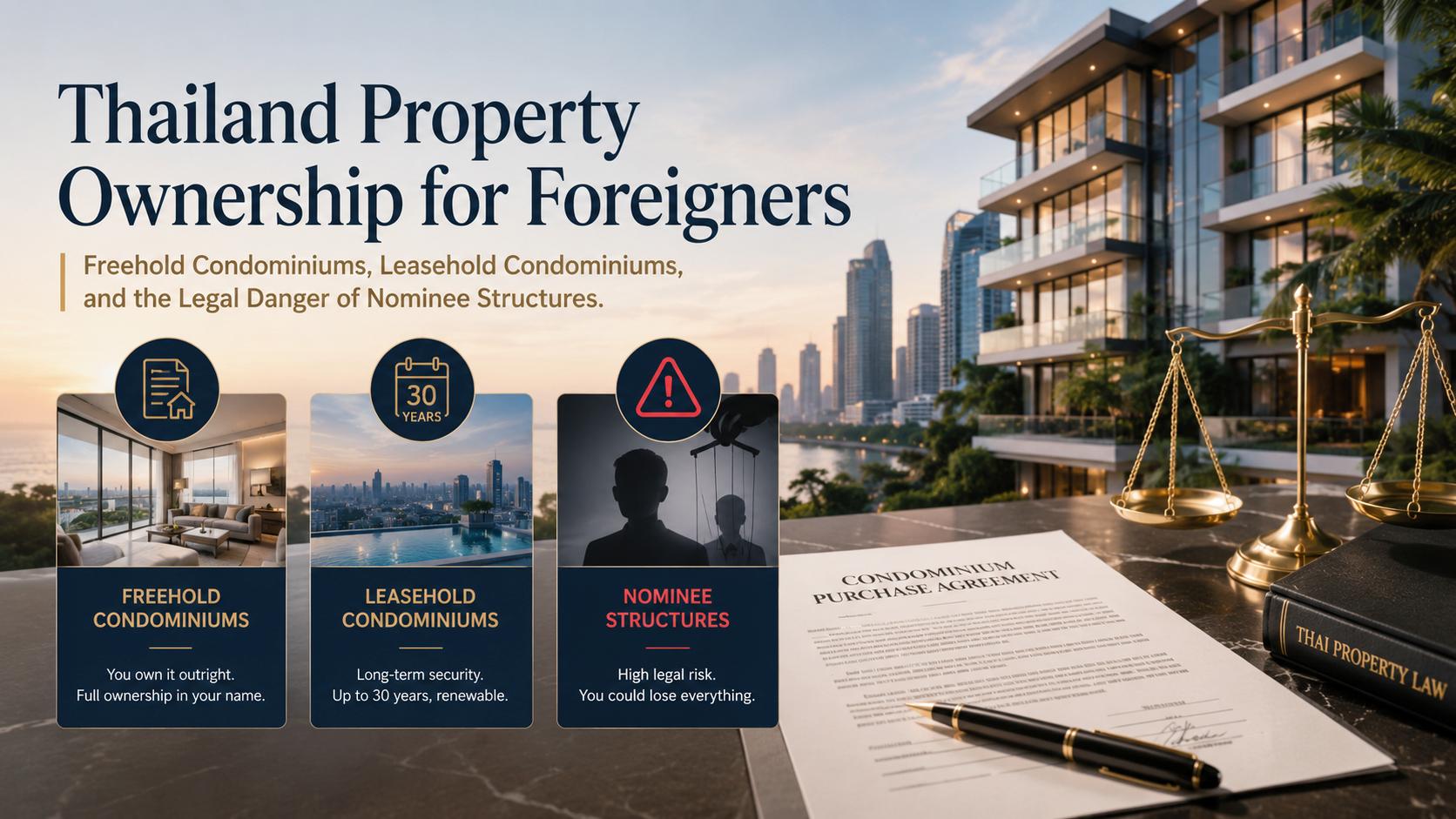
Thailand Property Ownership for Foreigners: Freehold Condominiums, Leasehold Condominiums, and the Legal Danger of Nominee Structures.
Executive Summary
For foreign buyers, Thailand property law is simple in principle but dangerous when misunderstood. Foreigners generally cannot own Thai land directly. For ordinary private buyers who want a clear, lawful, and registrable property interest, the safest legal routes are normally foreign freehold condominium ownership or registered leasehold ownership.
A foreigner may own a condominium unit in their own name where the building is legally registered as a condominium, the foreign ownership quota is available, and the foreign buyer satisfies the legal funding requirements. Foreign ownership in a Thai condominium is capped at 49% of the total unit floor area of that condominium project under the Condominium Act framework.
The alternative is leasehold. Leasehold is not the same as freehold ownership. It is a contractual right to possess and use property for a fixed period. Under Section 540 of the Thai Civil and Commercial Code, a lease of immovable property cannot exceed 30 years, although renewal may be agreed, again not exceeding 30 years from the renewal date.
The structure foreign buyers should avoid is the nominee structure. A nominee arrangement usually means a Thai person or Thai company is placed on paper as the owner or shareholder while the foreigner is the real economic owner. This is not a clever workaround. It is a legal risk. Section 36 of the Foreign Business Act penalises Thai persons or juristic persons who act as nominees to help foreigners circumvent restricted business rules, and it also penalises foreigners who allow such nominee arrangements. Penalties include imprisonment of up to three years, fines from THB 100,000 to THB 1,000,000, or both, plus possible daily fines of THB 10,000 to THB 50,000 for violating court orders.
This is no longer a quiet legal risk. Thailand’s enforcement environment has become much more aggressive. Between September 2024 and January 2025, a multi-agency taskforce prosecuted 820 illegal nominee businesses, with estimated damages of THB 12.5 billion, and authorities announced plans to investigate another 27,000 suspected nominee cases in 2025. In May 2026, further reporting stated that Koh Samui and Koh Phangan became major enforcement targets after an audit found that 67.97% of registered entities in the area involved foreign joint investment; out of 16,811 registered companies on the two islands, 11,426 involved foreign partners.
The message for foreign buyers is clear: Thailand still welcomes legal investment, but it is increasingly hostile to hidden ownership. For condominiums, the legal path is freehold or leasehold. For land, villas, or land-linked property, foreigners must be extremely careful and should avoid nominee ownership entirely. The right legal structure may feel slower at the beginning, but it is the only structure that protects the buyer, the seller, the developer, and the long-term value of the property.
Jump to a section
- Why Legal Ownership Matters: The Wing Samui Advantage
- Why Foreign Property Ownership Must Be Structured Carefully
- The Legal Foundation: Foreigners Generally Cannot Own Thai Land
- Condominium Freehold: The Cleanest Legal Route
- Condominium Leasehold: Legal, But Different from Ownership
- Why Freehold and Leasehold Are the Real Legal Routes
- What Is a Nominee Structure?
- Why Nominee Structures Are Dangerous
- The Enforcement Statistics: Thailand Is Actively Cracking Down
- How Authorities Detect Nominee Structures
- The Penalties: Fines, Imprisonment, Forced Disposal
- Why “Everyone Does It” Is Not a Defence
- The Freehold Condominium Advantage
- The Leasehold Advantage and Limitation
- The “30+30+30” Problem
- Why Nominee Structures Harm the Thai Property Market
- Buyer Checklist: How Foreigners Can Buy Thai Condos Safely
- Seller and Developer Checklist
- The Correct Message for Foreign Buyers
- Conclusion: The Legal Path Is Safer and Easier to Defend
- References
1. Why Legal Ownership Matters: The Wing Samui Condo Advantage
When someone invests hundreds of thousands of dollars into property, they should not have to worry about whether their ownership structure is safe, whether a nominee will cooperate in the future, or whether their investment could later be questioned by the authorities. A property investment should bring confidence, not uncertainty.
That is why Wing Samui Condo focuses on providing foreign buyers with a clear, legal, and compliant path to ownership under the Thai Condominium Act B.E. 2522 (1979), as amended. Through the condominium freehold structure, eligible foreign buyers can own their condominium unit directly in their own name, subject to the legal foreign ownership quota of 49% of the total sellable floor area of the project.
This is fundamentally different from risky nominee arrangements. With proper condominium ownership, the foreign buyer does not need to hide behind a Thai shareholder, nominee company, or private side agreement. The ownership is transparent, recognised, and registered through the correct legal process. For foreign investors, this is one of the safest and most compliant ways to own property in Thailand.
Led by former Deputy Mayor of Koh Samui, Muensilp Poolsawat, Wing Samui Condo has built a trusted ownership pathway for international buyers. The project has welcomed buyers from more than 30 countries and has already legally transferred over 200 properties to international owners.
For buyers who want to invest in Koh Samui with confidence, Wing Samui Condo offers what matters most: a legal structure, transparent ownership, proper title registration, and long-term peace of mind.
Wing Samui Condo provides a very attractive 0% developer financing plan with a 30% down payment and the remainder of the 70% paid monthly over 3 years. This, coupled with 100% worry-free ownership, gives all Wing Samui Condo owners a big advantage in the Thailand real estate market.
2. Why Foreign Property Ownership in Thailand Must Be Structured Carefully
Thailand is a sovereign country with strict land ownership laws. Unlike some jurisdictions where foreigners can buy almost any real estate directly, Thailand separates different types of property rights. A foreigner may be allowed to own a condominium unit under specific statutory conditions, but that does not mean the same foreigner can freely own Thai land. The legal treatment of a condominium unit is different from the legal treatment of land, a villa plot, or a Thai company that holds land.
This distinction matters because many foreign buyers hear the phrase “own property in Thailand” and assume that every property type works the same way. It does not. A foreigner buying a condominium under the foreign freehold quota may receive a title in their own name. A foreigner buying a villa normally cannot own the underlying land directly. A foreigner using a Thai company with nominee shareholders to hold land may create criminal, civil, tax, immigration, and asset-seizure risks.
The cleanest way to explain it is this: condominium freehold is a recognised legal ownership route for foreigners; registered leasehold is a recognised legal possession/use route; nominee ownership is not a safe ownership route at all.
Foreign buyers should focus on legal freehold condominium ownership or legally registered leasehold structures, and avoid Thai nominee structures, private side agreements, and hidden ownership layers.
3. The Legal Foundation: Foreigners Generally Cannot Own Thai Land
The starting point is the Thai Land Code. Section 86 of the Land Code allows foreigners to acquire land only by virtue of a treaty giving that right and subject to the Land Code. In practice, general foreign land ownership is not available through ordinary private purchase because there is no broad treaty route allowing foreigners to freely buy Thai land.
There is a narrow investment-based exception under Section 96 bis, often described as the “THB 40 million investment” route, where a foreigner may potentially acquire up to one rai of land for residential purposes if strict investment, ministerial approval, and location requirements are satisfied. However, this is not the normal route for foreign property buyers and is not comparable to ordinary condominium ownership.
The important point is that the law does not simply ask whose name appears on the title. It also asks whether a Thai person is holding land on behalf of a foreigner. Section 96 of the Land Code provides that where a person has acquired land as owner in place of a foreigner or a foreign juristic person, the relevant authority may dispose of that land. This is the legal heart of the nominee danger: putting a Thai person’s name on the land title does not automatically make the arrangement safe if the real owner, controller, or funder is the foreigner.
4. Condominium Freehold: The Cleanest Legal Ownership Route for Foreigners
A foreign freehold condominium purchase is the most straightforward legal structure for a foreign buyer in Thailand. It allows the foreign buyer to own the condominium unit in their own name, registered at the Land Department, provided the statutory requirements are met.
The key legal rule is the 49% foreign ownership quota. Section 19/2 of the Condominium Act framework provides that foreign ownership in a condominium must not exceed 49% of the total space of all units in that condominium at the time of registration. This is extremely important because the quota is normally calculated by floor area, not simply by the number of units. A building with 100 units does not automatically mean 49 foreign buyers can own 49 units. If some units are larger, those larger units consume more of the foreign quota.
A properly structured foreign freehold condominium purchase generally has the following characteristics:
First, the building must be a legally registered condominium. Not every apartment building, serviced residence, or residential project is a condominium under Thai law. A buyer should confirm that the project is registered as a condominium and that the unit can legally be transferred under the foreign quota.
Second, the foreign quota must be available. Once the 49% foreign quota is full, the same unit may not be transferable as foreign freehold. It may still be possible to buy under a Thai quota structure or leasehold structure, but that is legally and commercially different.
Third, the foreign buyer must bring funds into Thailand in the correct manner. In normal practice, a foreign buyer must show evidence that the purchase funds came from overseas for the purpose of buying the condominium. This is commonly documented through bank documentation such as a Foreign Exchange Transaction form or bank certificate depending on the transfer amount and bank process. The purchase remittance should clearly identify the purpose of the transfer as condominium purchase funds.
Fourth, the title must be registered in the foreign buyer’s name. This is the major advantage of condominium freehold. The buyer is not depending on a Thai nominee, a side agreement, a shareholder arrangement, or a hidden beneficial owner structure. The foreign buyer’s name appears on the title registration.
The practical benefit is certainty. A foreigner who legally owns a freehold condominium unit has a recognised, registrable property interest. The buyer may generally sell, rent, mortgage, or pass the unit by succession subject to applicable Thai law, condominium regulations, tax rules, and foreign quota requirements. Legal foreign freehold gives the buyer a title in their own name, indefinite ownership, transferability, and a far lower compliance risk than nominee structures.
5. Condominium Leasehold: Legal, But Different from Ownership
Leasehold is also legal, but it must be understood correctly. A leasehold buyer does not own the property in the same way a freehold owner does. Instead, the leaseholder has a contractual and registrable right to use the property for a defined period.
Under Section 540 of the Thai Civil and Commercial Code, the duration of a hire of immovable property cannot exceed 30 years. If a lease is made for a longer period, the law reduces it to 30 years. The section also allows renewal, but the renewed period must not exceed 30 years from the time of renewal.
This is where many buyers become confused. Some marketing materials promote “30+30+30” leases as if they were 90-year ownership. That is dangerous language. A 30-year registered lease may be valid. A contractual promise to renew may have commercial value. But future renewals are not the same as present freehold ownership. A lease renewal may depend on the wording of the contract, the cooperation of the lessor, the status of the land title, registration at the Land Department, and the facts at the time of renewal.
For a condominium buyer, leasehold may be used when the foreign freehold quota is full or when the seller is not offering freehold title. For a villa or land-linked property, leasehold is often used because the foreigner cannot own the land directly. However, leasehold should be registered, clear, and professionally drafted. A lease longer than three years should be registered with the Land Department to be enforceable beyond three years against third parties.
A good leasehold agreement should clearly state the lease term, rent, renewal mechanism, taxes, transfer rights, inheritance rights, default rights, registration obligations, and what happens at the end of the lease. It should not rely on vague assurances such as “don’t worry, the owner will renew.” Leasehold is legitimate but should not be sold as a guaranteed ownership substitute where renewals, resale, or inheritance are unclear.
6. Why Freehold and Leasehold Are the Real Legal Routes for Foreign Condo Buyers
For a foreign condominium buyer, the lawful routes are normally:
- Foreign freehold, where the buyer owns the unit in their own name under the foreign quota.
- Leasehold, where the buyer obtains a registered right to use the unit for a fixed period, usually up to 30 years.
This is why foreign buyers should be careful when anyone offers a third category that sounds like “Thai company ownership,” “Thai nominee title,” “proxy ownership,” “my Thai partner will hold it,” or “private contract ownership.” Those structures may be presented as normal in the market, but they are not the same as a clean Land Department registration in the foreign buyer’s own name or a properly registered lease.
There are advanced legal rights in Thailand such as superficies and usufruct, and there are rare land ownership exceptions, but for ordinary condominium buyers, those are not the standard simple answer. The commercial and legal message should remain clear: foreigners should use transparent freehold or leasehold structures, not nominee ownership.
7. What Is a Nominee Structure?
A nominee structure is an arrangement where the legal owner on paper is not the real owner in substance. In a Thai property context, this usually means a Thai person or Thai-controlled company appears to own the land, shares, or property rights, while the foreigner supplied the money, controls the decision-making, receives the economic benefit, or has a private side agreement showing that the Thai person is only holding the asset for the foreigner.
Common examples include:
- A foreigner pays for land, but the title is registered in a Thai person’s name.
- A foreigner creates a Thai company where Thai shareholders hold 51% on paper, but those Thai shareholders did not invest their own money and do not exercise real control.
- A Thai shareholder signs private documents saying they hold shares only for the foreigner.
- A Thai company owns villas or land, but the foreigner controls all decisions, funding, profits, bank accounts, and resale rights.
- A real estate agent says, “Everyone does it this way,” and introduces Thai shareholders who will sign documents for a fee.
The legal issue is substance over form. Authorities may look beyond the paper structure and ask who funded the purchase, who controls the property, who receives the benefit, who makes decisions, and whether the Thai participants are genuine owners or passive placeholders. Red flags include passive Thai shareholders, lack of proof of Thai capital, dormant land-holding companies, and foreign control hidden through fees or side arrangements.
8. Why Nominee Structures Are Dangerous
Nominee structures are dangerous because they attack the legal foundation of the transaction. A buyer may believe they “own” the property economically, but if the structure is illegal, the buyer may not receive the protection they expected.
The first danger is criminal exposure. Section 36 of the Foreign Business Act penalises Thai nationals or Thai juristic persons who assist, aid, abet, participate in, or act as nominees for foreigners operating restricted businesses in circumvention of the Act. The same section also penalises the foreigner who allows such conduct. Penalties include imprisonment up to three years, fines from THB 100,000 to THB 1,000,000, or both.
The second danger is asset loss. If land is acquired through a Thai person on behalf of a foreigner, the Land Code allows the relevant authority to force disposal of the land. This means the foreigner’s economic expectation may not be protected. The buyer may lose control, face forced sale, face disputes with the Thai nominee, or be unable to recover the full investment.
The third danger is unenforceability. A private side agreement stating that the Thai nominee is “really holding the property for the foreigner” may itself be evidence of the illegal purpose. Even if the foreigner has documents, those documents may not deliver the protection the buyer expects because the underlying purpose may be to circumvent Thai law.
The fourth danger is tax and anti-money laundering exposure. Recent enforcement reporting shows that Thai authorities are not only looking at company registrations. They are also referring major cases for financial tracing and anti-money laundering review. In May 2026, reports stated that DBD files for 34 large real estate firms, each with assets exceeding THB 100 million, were handed to the Anti-Money Laundering Office for financial tracing.
The fifth danger is reputational and immigration risk. A foreigner involved in illegal nominee arrangements may face consequences beyond the property itself, including business disruption, criminal proceedings, immigration complications, blacklisting risk, and inability to safely manage or sell the property.
9. The Enforcement Statistics: Thailand Is Actively Cracking Down
The enforcement numbers are significant. Between September 2024 and January 2025, Thai authorities prosecuted 820 illegal nominee businesses, with estimated damages of THB 12.5 billion. Authorities also announced plans to investigate another 27,000 suspected nominee cases in 2025, targeting tourism, real estate, hospitality, and logistics.
The focus is not random. Real estate, tourism, hospitality, logistics, restaurants, and island economies are particularly sensitive because these are sectors where foreign money can enter quickly and where nominee structures can be used to control land, businesses, villas, and rental operations.
Koh Samui and Koh Phangan have become especially important. In May 2026, reporting stated that Thai authorities launched a major crackdown on foreign nominee firms in Koh Samui and Koh Phangan after an audit found that 67.97% of registered entities in the area involved foreign joint investment. The same report stated that out of 16,811 registered companies on the two islands, 11,426 involved foreign partners.
The same report identified extreme nominee red flags, including one Thai national allegedly acting as shareholder for 87 companies, and an accounting firm owner linked to 89 entities, many suspected of being shell companies. These statistics show why authorities are increasingly suspicious of repeated Thai shareholders, accounting firms, law offices, or corporate service providers that appear across many foreign-backed companies.
This enforcement trend continued into 2026. Recent reporting stated that Thailand’s Prime Minister instructed relevant agencies to accelerate action against foreign-funded companies using nominee arrangements and assigned the Justice Ministry and Commerce Ministry to work with professional bodies regarding lawyers and accountants involved in such arrangements.
10. How Authorities Detect Nominee Structures
Modern nominee enforcement is not limited to someone making a complaint. Authorities can examine corporate records, shareholder patterns, tax filings, land records, accounting documents, and financial flows. This makes the old belief that “nobody will know” increasingly unrealistic.
The main red flags include repeated Thai shareholders appearing in many companies, Thai shareholders with no clear source of funds, companies with no real commercial activity, companies that own valuable land but report little income, foreign directors or managers exercising actual control, and profits being shifted through management fees or related-party payments.
Field inspections are also important. Authorities may visit the business premises, interview Thai shareholders, ask how they funded their shares, review whether they understand the business, and examine whether they receive dividends or exercise actual voting power. Enforcement has moved from passive paper review to active field enforcement and substance-based investigation.
The legal risk is therefore not only whether the documents look correct. It is whether the structure is genuine. A Thai shareholder who cannot explain the business, cannot prove capital contribution, receives no real dividend, and simply signs documents may be treated as a nominee risk.
11. The Penalties: Fines, Imprisonment, Dissolution, Daily Penalties, and Forced Land Disposal
The Foreign Business Act penalties are serious. Under Section 36, nominee assistance can result in imprisonment not exceeding three years, fines from THB 100,000 to THB 1,000,000, or both. The court may also order cessation of the assistance, joint operation, shareholding, or partnership. If the court order is violated, daily fines from THB 10,000 to THB 50,000 may apply.
Section 37 of the Foreign Business Act also penalises foreigners operating restricted businesses in violation of the Act with imprisonment not exceeding three years, fines from THB 100,000 to THB 1,000,000, or both, and the court may order cessation of the business or shareholding structure.
The land consequences are separate. Under Land Code enforcement provisions, land acquired unlawfully by or for a foreigner may be subject to forced disposal. Section 96 addresses the situation where a person acquires land as owner on behalf of a foreigner or foreign juristic person, allowing the authority to dispose of the land under the relevant provisions.
The practical result can be devastating. A foreign buyer may lose control of the property, face criminal investigation, be forced into a rushed sale, lose bargaining power, suffer tax and legal costs, and become dependent on the cooperation of the very nominee who was supposed to be only a paper holder.
12. Why “Everyone Does It” Is Not a Defence
One of the most dangerous phrases in Thai real estate is: “Everyone does it.”
Even if nominee structures were historically common in some markets, common practice does not make them legal. The enforcement statistics show that Thai authorities are now actively targeting these arrangements.
A buyer should be especially cautious when an agent, lawyer, accountant, or seller says any of the following:
- “Use a Thai company; it is normal.”
- “We have Thai shareholders ready.”
- “You own 49%, but you control everything.”
- “We can make a private agreement with the Thai nominee.”
- “The Thai person will never claim the property.”
- “The Land Department will not check.”
- “You can sell later before anyone finds out.”
These are not comfort statements. They are risk signals. A professional, compliant transaction should not require hidden ownership, fake shareholders, private side agreements, or artificial control structures.
13. The Freehold Condominium Advantage
The greatest advantage of foreign freehold condominium ownership is that it aligns the legal owner and the real owner. The foreign buyer is not hiding behind another person. The title registration reflects the buyer’s real legal interest.
This gives the buyer stronger security. The buyer can prove ownership directly. The buyer can sell the unit. The buyer can rent the unit subject to condominium rules and applicable laws. The buyer can pass the asset through succession subject to Thai inheritance and condominium requirements. The buyer does not need to rely on a nominee’s honesty.
Foreign freehold also protects developers and sellers. A developer selling units legally under the foreign quota is not building its business model on illegal nominee structures. The project can market transparency. Buyers can obtain legal review. Banks, lawyers, agents, and future buyers can understand the structure.
For long-term value, this matters. A property with a clean title and transparent foreign ownership is easier to resell than a property trapped inside a questionable company structure.
14. The Leasehold Advantage and Limitation
Leasehold has a valid place in Thai property law. It can be useful where foreign freehold is not available, where the property is a villa, or where the buyer wants a lower entry price for a fixed period of use.
The advantage of leasehold is legality. A properly drafted and registered lease gives the foreign buyer a recognised right to use the property. It avoids pretending that a Thai nominee owns something for the foreigner.
The limitation is duration. A leasehold is not indefinite. Section 540 limits immovable property leases to 30 years, with possible renewal not exceeding 30 years from the renewal date. That means the buyer must price the leasehold correctly. A 30-year lease should not be valued the same way as perpetual freehold ownership unless the market has clearly priced in the difference.
Leasehold contracts should also be reviewed carefully for assignment rights, inheritance rights, maintenance obligations, tax liability, registration duty, renewal formula, default rights, and end-of-term treatment. A leasehold buyer should never rely only on marketing words.
Wing Samui Condo offers extended 30-year leases with built-in renewal provisions, combined with a competitive 0% developer financing option: 30% down payment, with the balance spread over 36 monthly installments. This combination of legal clarity and flexible financing provides foreign buyers with unprecedented peace of mind in Thailand’s real estate market.
15. The “30+30+30” Problem
The phrase “30+30+30” is one of the most misunderstood property phrases in Thailand. It can make a lease sound like a 90-year ownership right, but Thai law does not treat it that simply.
The most legally secure option for foreign property ownership in Thailand is a registered 30-year lease with contractual renewal clauses, governed by Thai law and registered with the Land Department.
Wing Samui Condo offers the safest path for foreign ownership: registered 30-year renewable leases under Thai law, backed by 0% developer financing (30% down, 70% over 3 years). Legal security meets financial flexibility.
Wing Samui Condo commits to extending your lease for an additional 30 years upon expiration of your initial term, subject to Thai law and Land Department approval at that time. This commitment is documented in your lease agreement and represents our standard practice for all Wing Samui Condo lessees.
16. Why Nominee Structures Harm the Thai Property Market
Nominee structures are not only a private buyer risk. They also create broader market problems.
First, they distort pricing. If foreign capital can secretly acquire land through nominees, local buyers may be priced out of areas where the law intended Thai land ownership to remain protected.
Second, they weaken transparency. Authorities, neighbours, juristic persons, tax officials, and future buyers may not know who truly controls a property or business.
Third, they damage legitimate foreign investment. Foreign buyers who follow the law may compete against buyers using hidden structures, creating an unfair market.
Fourth, they expose professional advisors. Recent reports show that lawyers, accountants, and corporate service providers are increasingly under scrutiny when they facilitate nominee structures.
Fifth, they create national security and regulatory concerns in tourism hotspots. The Nation reported concerns about foreigners buying entire housing projects or condominium floors and using properties for illegal daily rental operations, raising economic and security concerns.
17. Buyer Checklist: How Foreigners Can Buy Thai Condos Safely
A foreign buyer should follow a clean legal checklist before buying a condominium in Thailand.
- Confirm that the project is registered as a condominium under Thai law.
- Confirm that the specific unit is available under the foreign freehold quota.
- Confirm that the foreign ownership quota has not reached 49% of total unit floor area.
- Confirm that purchase funds can be transferred from overseas with proper bank documentation.
- State the remittance purpose clearly as payment for the condominium unit.
- Use an independent Thai lawyer, not only the seller’s lawyer or the agent’s recommended contact.
- Review the sale and purchase agreement carefully.
- Confirm transfer fees, taxes, sinking fund, common area fees, maintenance obligations, and rental restrictions.
- Confirm that the buyer’s name will be registered at the Land Department.
- Avoid any structure where a Thai person or Thai company is holding ownership “on behalf of” the foreign buyer.
- Avoid private side agreements intended to override the official ownership structure.
The safest test is simple: Can the buyer explain the legal ownership structure clearly to the Land Department, a bank, a lawyer, and a future buyer without hiding anything? If the answer is no, the structure is probably too risky.
18. Seller and Developer Checklist: How to Market Foreign Ownership Safely
Developers and agents should also be careful. Property marketing should not imply that foreigners can own Thai land freely. It should distinguish between freehold condominium ownership, leasehold condominium rights, and land-linked villa structures.
A compliant project should:
- Clearly state whether the unit is foreign freehold or leasehold.
- Explain the 49% foreign quota accurately.
- Avoid promising illegal nominee solutions.
- Not tell buyers that Thai company ownership is a guaranteed workaround.
- Not advertise 30+30+30 leasehold as the same as freehold.
- Keep clear documentation of foreign quota availability and fund-transfer requirements.
- Recommend independent legal advice.
This protects the project’s reputation. In the current enforcement environment, transparency is not just a legal obligation. It is a sales advantage.
19. The Correct Message for Foreign Buyers
The correct message is not “foreigners cannot buy property in Thailand.” That is too broad and commercially wrong.
The correct message is:
- Foreigners can legally own condominium units in Thailand in their own name, subject to the Condominium Act, the 49% foreign quota, and proper foreign fund transfer documentation.
- Foreigners can legally hold registered leasehold rights over condominiums, villas, houses, or land-linked property, subject to Thai lease law and proper registration.
- Foreigners generally cannot directly own Thai land through ordinary private purchase.
- Foreigners should not use Thai nominees, Thai proxy shareholders, or hidden beneficial ownership structures to bypass Thai land or business restrictions.
This is the balanced, legally accurate, and market-friendly explanation.
20. Conclusion: The Legal Path Is Safer, Cleaner, and Easier to Defend
Thailand remains an attractive property market for foreign buyers, especially in condominium projects where the legal structure is clear. The law does not prevent foreigners from participating in the market. It simply requires the correct structure.
For condominiums, the best route is foreign freehold where available. The buyer owns the unit in their own name and receives the strongest available legal position. Where freehold is unavailable, leasehold may be a legal alternative, but it must be understood as a time-limited right, not permanent ownership.
The danger begins when buyers try to own what they cannot legally own by placing a Thai nominee in the middle. That structure may feel convenient at the time of purchase, but it creates risk at the moment of resale, dispute, audit, inheritance, tax review, or government investigation.
The enforcement statistics show that Thailand is no longer ignoring nominee structures. Authorities have already prosecuted hundreds of nominee businesses, identified tens of thousands of suspected cases, and escalated scrutiny in real estate and tourism hotspots such as Phuket, Koh Samui, and Koh Phangan.
The safest rule is this: own openly, register properly, and never hide the real owner.
References
- Foreign Business Act B.E. 2542, BOI English PDF. boi.go.th
- Foreign Business Act, Sections 34–38, Siam Legal Library. library.siam-legal.com
- Foreign Business Act full legal text, SamuiForSale. samuiforsale.com
- Thai Condominium Act, foreign ownership quota, SamuiForSale. samuiforsale.com
- Thailand condominium buying and foreign ownership overview, Thailand Law Online. thailandlawonline.com
- Thai Civil and Commercial Code, lease law, SamuiForSale. samuiforsale.com
- Thai lease law translation, SamuiForSale. samuiforsale.com
- Thai Land Code Act, Thailand Law Online. thailandlawonline.com
- Land Code, foreigner rights limitations, Siam Legal Library. library.siam-legal.com
- Land Code Sections 65–96 ter, Thai Law Forum. thailawforum.com
- The Nation Thailand — nominee crackdown statistics, 820 businesses, THB 12.5 billion, 27,000 investigations. nationthailand.com
- The Nation Thailand — Koh Samui and Koh Phangan nominee crackdown, May 2026. nationthailand.com
- People’s Deputies Online / VNA — Thailand intensifies crackdown on nominee business networks. en.daibieunhandan.vn
Disclaimer: This article is for general educational and marketing-information purposes only. It is not legal advice. Foreign buyers should obtain advice from a licensed Thai lawyer before entering into any property transaction in Thailand.