World Bank's 2026 Income Classifications: Thailand Remains Upper-Middle Income
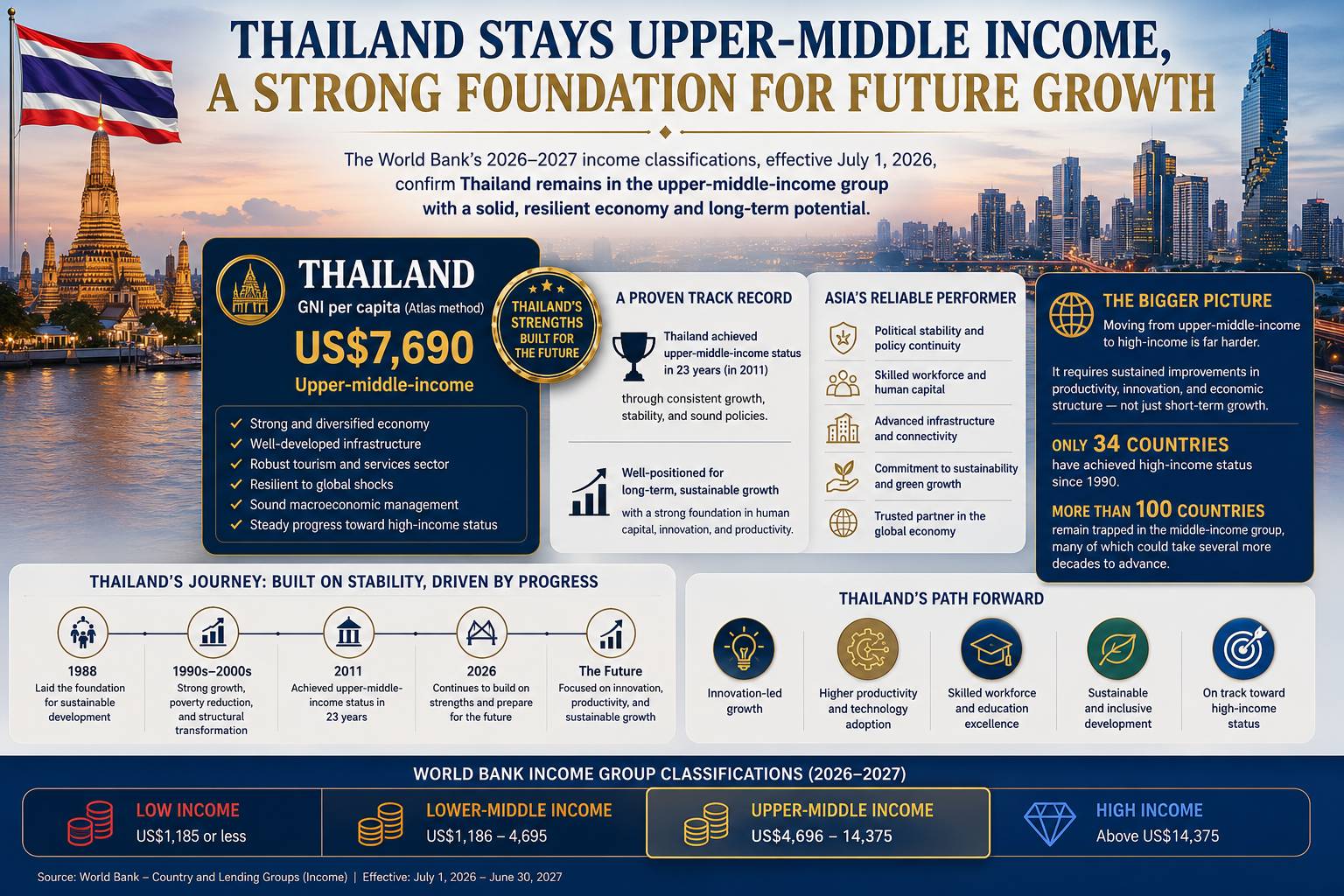
The World Bank has published its annual country income classifications for 2026–2027, and the headline for Southeast Asia is a positive one: Thailand continues to be firmly ranked as an upper-middle-income economy. Effective from 1 July 2026, the new classification confirms Thailand’s standing as one of the region’s most established and resilient economies.
Thailand’s 2026 Income Classification at a Glance
Thailand recorded a Gross National Income (GNI) per capita of US$7,690, keeping it comfortably within the upper-middle-income band and on a steady path toward the high-income threshold of US$14,375. The classification is calculated using the World Bank Atlas method, which measures a country’s ability to raise average incomes over time — reflecting labour productivity, economic structure, and the capacity for long-term value creation rather than short-term GDP swings alone.
What the Upper-Middle-Income Status Means
Being classified as upper-middle-income places Thailand in the company of well-developed, diversified economies. It signals mature financial and legal systems, modern infrastructure, and a broad base of industries spanning manufacturing, agriculture, technology, and a world-leading tourism sector. For international investors and residents, it reflects a country with the stability and services expected of an advanced emerging market.
The Foundations Behind Thailand’s Strength
Thailand’s consistent standing is underpinned by several enduring strengths:
- A globally recognised tourism industry that continues to attract tens of millions of visitors each year, supporting jobs, services, and regional development.
- Modern infrastructure — international airports, expanding road and rail networks, world-class hospitals, and reliable utilities.
- A diversified economy that balances exports, manufacturing, agriculture, and a fast-growing digital and services sector.
- An attractive lifestyle proposition for expatriates, retirees, and remote professionals, backed by a low cost of living relative to income.
These factors combine to make Thailand not only economically stable but also one of the most desirable places in Asia to live, work, and invest.
The Path to High-Income Status
Moving from upper-middle-income to high-income status is a milestone only a select group of nations have reached — just 34 economies have made the jump since 1990. The transition rewards sustained gains in productivity, innovation, and economic sophistication. Thailand’s ongoing investment in digital infrastructure, green energy, high-value tourism, and skilled industries positions it to keep climbing. (For context, Vietnam entered the upper-middle-income group for the first time this year, underscoring how competitive and dynamic the wider region has become.)
Why This Matters for Property Investors
A stable, upward-trending economy is one of the most important backdrops for real estate. Rising average incomes, strong tourism demand, and continued infrastructure investment all support long-term demand for quality property — particularly in premier destinations such as Koh Samui, where lifestyle appeal and international demand meet limited supply of well-built, professionally managed homes.
At Wing Samui Condo, we see Thailand’s economic resilience reflected in the steady, ongoing interest from international buyers seeking a home or a foothold on one of the world’s most beautiful islands. As the country continues its journey toward high-income status, Koh Samui remains a compelling place to own a piece of Thailand’s future.
Interested in owning at Wing Samui Condo? Get in touch with our team to learn more about availability and ownership options.